Key Takeaways: How to Replace Disconnected Systems with Unified ERP for Life Safety Contractors
- Disconnected systems force life safety contractors to rely on workarounds, duplicate data entry, and delayed reporting that erodes margins.
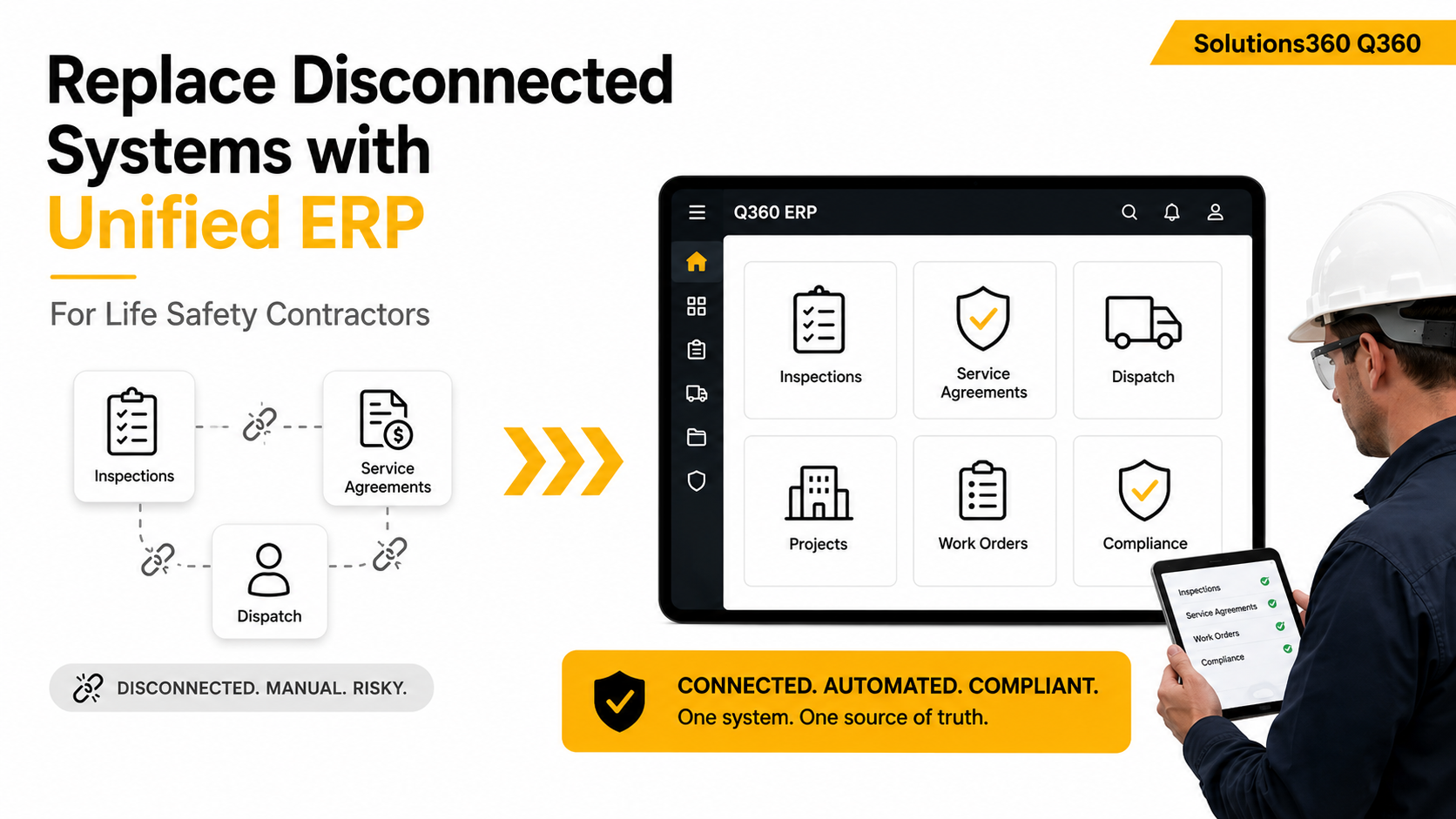
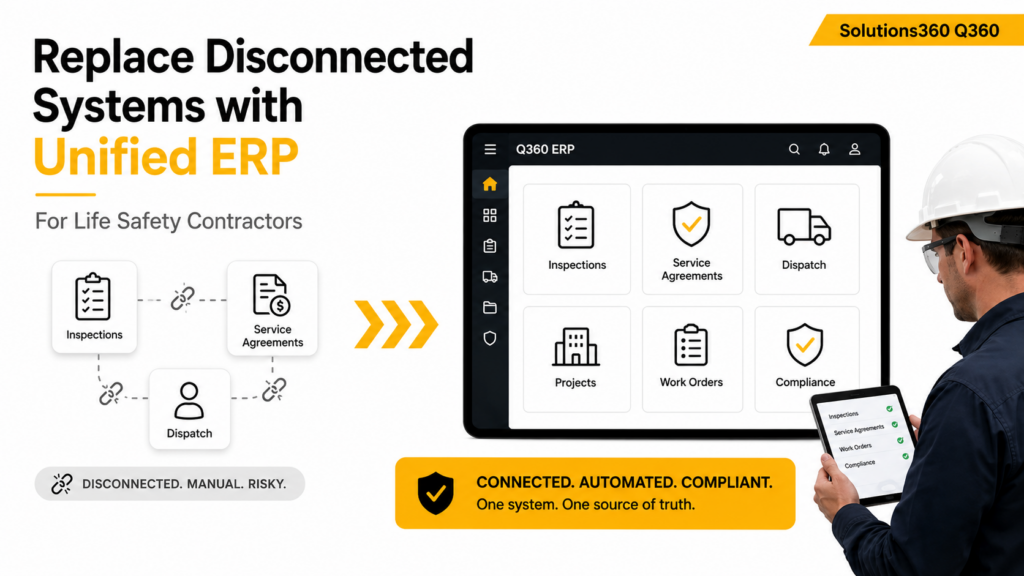
- A unified ERP connects inspections, service agreements, dispatch, project management, and accounting in one operational database.
- Solutions360’s Q360 platform gives life safety contractors real-time visibility into job costs, technician utilization, and cash flow.
- Replacing fragmented tools reduces compliance risk by keeping inspection records, deficiency tracking, and audit documentation in sync.
- The right platform should be purpose-built for the integration industry, not a horizontal ERP adapted with workarounds.
Why Life Safety Contractors Outgrow Disconnected Software
Running a life safety business means managing inspections, service agreements, emergency repairs, project installations, technician scheduling, inventory, compliance documentation, and accounting at the same time. Each function depends on the others. When one area falls behind or works from outdated information, the impact shows up across the business.
That is where many fire protection and life safety contractors begin to feel the limits of disconnected tools. A basic accounting platform might handle invoices. A separate CRM might track opportunities. A field service tool might help with dispatch. Spreadsheets fill the gaps for forecasting, job costing, or inspection tracking.
On their own, each tool may seem useful. The problem starts when the business has to rely on disconnected systems to manage work that is deeply connected. For life safety contractors, that disconnect creates more than an efficiency problem. It can lead to missed billing, delayed cash flow, inaccurate forecasting, and jobs that lose margin before leadership has a chance to correct course.
What Are the Signs Your Current Systems Are Holding You Back?
Fragmented operations create familiar pain points that become more obvious as your business grows. Recognizing these patterns early helps you understand when your current software stack is no longer serving the business.
You may notice that recurring inspections are easy to miss or hard to track across multiple tools. Service history might be incomplete or buried in disconnected databases. Parts usage in the field is not updated in real time, making inventory accuracy a constant challenge.
Billing often lags behind completed work because information has to move between systems before finance can act. Managers may lack a reliable view of technician productivity or job profitability. Compliance paperwork takes too long to assemble because documentation lives in separate places.
Perhaps most critically, sales, service, operations, and finance all work from slightly different versions of the truth. In a business where timing, documentation, and accountability matter, that kind of fragmentation holds back growth.
How Do Disconnected Systems Affect Job Costing and Profitability?
For life safety contractors, job costing is one of the most important parts of running a profitable operation. The original estimate is only the starting point. Profitability depends on what happens after the job is won, including labor hours, materials, subcontractor costs, equipment, change orders, delays, and billing timing.
If project managers cannot see job costs while a job is active, they are forced to manage based on instinct instead of real-time information. If accounting only sees the financial impact after the work is complete, the business loses the chance to make adjustments while there is still time to protect the margin.
That is why life safety business software needs to connect operational activity directly to financial outcomes. Project teams should understand where a job stands before it becomes a problem. Finance leaders should see how active projects affect cash flow. Executives should forecast with confidence instead of relying on static spreadsheets.
Why Do Life Safety Contractors Have Unique Software Needs?
Life safety and fire protection companies are not generic service businesses. Yes, they schedule technicians. Yes, they manage inventory. Yes, they issue invoices. But they also operate in an environment where inspections, testing, maintenance, and documentation carry real regulatory and safety consequences.
That changes the software conversation entirely. A basic accounting platform may be fine for bookkeeping, but it will not help much when you need to coordinate recurring inspections across a large customer base. A field service tool may help with work orders, but it may fall short when you need better financial reporting, inventory visibility, and compliance documentation all tied together.
This industry needs systems that can handle the operational reality of recurring inspection schedules, service dispatch, equipment tracking, customer-specific service histories, compliance documentation, contract renewals, billing tied to actual work completed, and real-time reporting across teams.
What Does a Unified ERP Platform Actually Change?
When people hear “ERP,” they sometimes think of finance first. But for a life safety company, the real value of a connected platform shows up across the entire operation. The goal is not to digitize paperwork. The goal is to build a more responsive, data-informed, and scalable operation.
Consider this workflow: A recurring inspection is scheduled automatically based on service requirements. The technician receives the job in the field, completes the inspection, records notes, updates any deficiencies, and logs parts used. That information flows back into the system immediately.
Operations can see job status in real time. Finance can generate accurate billing faster. Managers can run reports on completion rates, technician activity, outstanding issues, and customer trends without stitching together data from multiple systems. That is a completely different operating model from one built around disconnected handoffs.
How Does Unified ERP Improve Inspection and Compliance Workflows?
Inspections and compliance documentation are where life safety contractors face some of their greatest operational risks. The work is not done just because the technician leaves the site. The documentation matters just as much as the physical inspection.
Companies need reliable records for inspections, risk assessments, deficiencies, maintenance history, and code-related compliance. If those records are incomplete, scattered across systems, or difficult to retrieve, the business carries unnecessary risk during audits and renewals.
A unified platform keeps inspection data, deficiency tracking, and compliance documentation connected to the customer record, the service agreement, and the financial transaction. When an inspector identifies a deficiency, that information can flow directly into a repair quote, a follow-up work order, and eventually an invoice without re-entering data at each step.
Solutions360’s Q360 platform helps life safety contractors maintain that connection between field activity and back-office operations. Inspection results, service history, and billing stay linked in a single system of record.
What Should a Purpose-Built ERP Include for Life Safety Contractors?
Not every ERP is designed for the complexity of the life safety industry. Generic platforms often require extensive customization and workarounds to handle the specific workflows that contractors manage every day. When evaluating options, look for capabilities that address the full operational lifecycle.
Project Management with Job Costing
Installation projects need budget tracking, labor planning, change order management, and milestone billing. Your platform should connect project activity to financial outcomes so you can see profitability while work is still in progress, not just after the job closes.
Service Agreement and Recurring Work Management
Life safety contractors often manage hundreds or thousands of recurring service agreements. Your system should automate scheduling, track renewal dates, and connect service activity to billing without manual intervention.
Dispatch and Technician Scheduling
Emergency calls, scheduled inspections, and project work all compete for technician time. The platform should support skills-based scheduling, route optimization, and real-time visibility into technician availability and workload.
Inventory and Parts Management
Parts visibility affects both service quality and margins. Your platform should track inventory across trucks, warehouses, and job sites, with automatic updates when technicians use materials in the field.
Integrated Accounting and Financial Reporting
Finance should not sit downstream from operations waiting on incomplete information. A unified platform connects field activity directly to invoicing, general ledger, and financial reporting so billing happens faster and cash flow improves.
How Do You Evaluate Whether to Replace Your Current Systems?
The decision to replace disconnected systems with a unified platform is significant. Before making a move, ask yourself a few practical questions about your current state and your operational goals.
First, how much time does your team spend on duplicate data entry? If the same information gets entered into multiple systems, you are paying for that inefficiency in labor costs and error rates. Second, how long does it take to close your books each month? If reconciliation between operational systems and accounting takes days or weeks, your reporting is always behind reality.
Third, can your leadership team see real-time profitability by job, by customer, or by service line? If the answer requires pulling together spreadsheets from multiple sources, you lack the visibility needed to make timely decisions. Finally, are you confident in your compliance documentation? If preparing for an audit means scrambling to assemble records from different places, your current systems are creating risk.
What Questions Should You Ask Software Vendors?
When evaluating unified ERP platforms, the questions you ask matter as much as the features on a checklist. Here are the areas that deserve attention:
Does the system connect operations and finance? If service execution and billing still live in separate worlds, friction will remain. Look for platforms where field activity flows directly into accounting without manual handoffs.
Can it support recurring inspections and ongoing service work? A life safety company needs more than ad hoc job management. Recurring activity is central to the business model, and the platform should treat it that way.
How well does it handle documentation and compliance workflows? Generic service software may not go far enough. Ask how the platform manages inspection records, deficiency tracking, and audit trails.
Is the platform purpose-built for the integration industry? Horizontal ERPs adapted with workarounds create long-term maintenance burdens. A platform designed for specialty contractors will require less customization and deliver faster time to value.
How Does Solutions360 Help Life Safety Contractors Replace Disconnected Systems?
Solutions360 built Q360 specifically for specialty contractors and technology integrators who need one connected system for sales, projects, service, accounting, reporting, and forecasting. Instead of relying on separate tools and workarounds, teams work from a single source of truth.
For life safety businesses, that means better visibility from the first sales opportunity through project delivery, service work, inspections, billing, and financial reporting. Sales can see customer and opportunity details. Operations can manage project work with financial context. Service teams can track work orders and agreements. Accounting can bill with better accuracy. Leadership can see performance across the business and make decisions based on real-time data.
The Q360 Project Management module supports planning, execution, resource scheduling, and profitability tracking for complex integration projects. The Q360 Field Service and Dispatch tools manage work orders, technician scheduling, and mobile field operations. Accounting and financials connect directly to operational activity, so billing happens faster and month-end close becomes more predictable.
What Does the Transition Process Look Like?
Moving from disconnected systems to a unified platform requires planning, but the process does not have to disrupt your operations. The key is working with an implementation partner who understands your industry and your specific workflows.
Start by documenting your current processes, including where data enters the business, how it moves between teams, and where bottlenecks occur. This baseline helps you understand what the new platform needs to support and where the greatest opportunities for improvement exist.
Next, prioritize the areas where you need visibility most urgently. For many life safety contractors, that means job costing and billing. Getting these workflows into a unified system first creates immediate value while you migrate other functions.
Finally, plan for training and adoption. A new platform only delivers value if your team uses it consistently. Build in time for training, establish clear expectations for data entry, and create accountability for following the new processes.
How Do You Measure Success After Implementation?
Once your unified platform is in place, you should be able to track meaningful improvements across several dimensions. These metrics help you understand whether the investment is delivering the expected return.
Days to invoice: How quickly does completed work turn into an invoice? A unified platform should reduce the lag between field completion and billing.
Month-end close time: How many days does it take to close your books? Eliminating reconciliation between disconnected systems should accelerate this process.
Technician utilization: What percentage of technician time is billable? Better scheduling and visibility should improve utilization rates.
Job margin accuracy: How often does actual job profitability match your estimates? Real-time job costing helps you identify variances earlier and protect margins.
Compliance audit preparation: How long does it take to assemble documentation for an audit? Unified records should make this process faster and less stressful.
In Summary: Building Operational Discipline Through Unified Systems
Life safety contractors operate in a demanding industry where details matter. Projects, service, inspections, labor, materials, billing, and compliance workflows all need to stay connected. When they do not, the business is left trying to manage complex work with incomplete information.
Generic software may help with isolated tasks, but it often cannot support the full complexity of the life safety business. A unified ERP platform gives contractors the visibility they need to protect margins, improve cash flow, strengthen customer relationships, and make smarter decisions.
For companies that are growing, scaling, or tired of managing the business through disconnected tools, it may be time to look beyond generic software. The goal is not simply to replace systems. The goal is to give your business the structure it needs to run more profitably, more efficiently, and with more control.
FAQs About Replacing Disconnected Systems with Unified ERP for Life Safety Contractors
What is a unified ERP platform for life safety contractors?
A unified ERP platform connects all your core business functions—inspections, service agreements, dispatch, project management, inventory, and accounting—in a single database. Solutions360’s Q360 is purpose-built for integration contractors, giving you one view of operations and financials instead of juggling disconnected tools.
How does unified ERP improve job costing accuracy?
When labor, materials, and project activity flow into the same system as your accounting, you can see job profitability while work is still in progress. This real-time visibility helps you catch margin erosion early. Solutions360 connects field execution directly to financial reporting so you know where every job stands.
Can unified ERP help with compliance and inspection documentation?
Yes. A unified platform keeps inspection records, deficiency tracking, and service history connected to the customer record and billing. When auditors ask for documentation, you can retrieve it from one system instead of assembling records from multiple sources. Q360 maintains this connection across your entire service lifecycle.
How long does it take to implement a unified ERP system?
Implementation timelines vary based on company size and complexity, but most life safety contractors can begin seeing value in core functions like billing and job costing within a few months. Solutions360 works with you to prioritize the workflows that matter most and build adoption over time.
What makes Solutions360 different from generic ERP platforms?
Solutions360 built Q360 specifically for specialty contractors and technology integrators. The platform handles project management, field service, inspections, and accounting in workflows designed for your industry. You spend less time on customization and workarounds because the system already understands how integration businesses operate