
Q360 vs Tigerpaw
Tigerpaw is a well-known PSA platform built around service, ticketing, and dispatch. Q360 is designed to run the entire integration business — including installation projects, inventory, job costing, and long-term customer relationships. The difference shows up when projects and service must operate together.
How Tigerpaw Is Typically Used
Tigerpaw excels at service tickets and dispatch, time and expense tracking, quotes and CRM, and service-oriented inventory. For companies that are primarily service-driven, this provides strong visibility into technician activity and customer interactions.
Where Integrators Feel Friction
Systems integrators do more than run service tickets. They run large installation projects requiring purchasing, staging, change orders, real-time margin tracking, and project-to-service transitions. PSA platforms like Tigerpaw are optimized for service workflows, not complex project and job cost control. As projects grow, integrators often need to add accounting and project systems alongside their PSA.
How Q360 Handles This
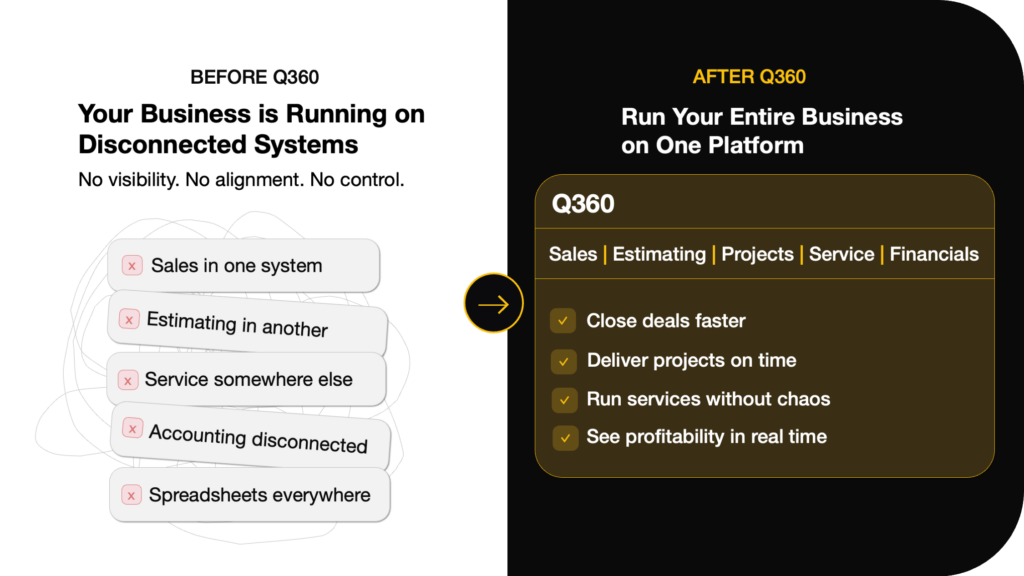
Q360 combines PSA-style service management with full ERP-grade project, inventory, and financial control. Projects, service, technicians, and financials all operate on one platform. Installed systems become the foundation for future service and renewals — eliminating the split between PSA and ERP.
How They Compare for Integrators
| What Integrators Evaluate | Q360 | Tigerpaw |
|---|---|---|
| Core ERP | Built for integrators | PSA for MSP & Telecom |
| Field service and dispatch | Native | Separate application |
| Project job costing | Integration-focused | Project-based |
| Installed base by site | Core concept | Not native |
| Service agreements | Built-in | Configured |
| Inventory by truck and job | Designed for it | Warehouse-focused |
| Project-to-service handoff | Automatic | Process-driven |
| Overall fit for integrators | High | Depends on integrations |
| Embedded AI Agents | Yes | No |
Choose Q360 if…
You run both projects and service as one business and need ERP-grade project and financial control alongside dispatch.
Choose Tigerpaw if…
Your operation is primarily service-driven and project complexity is low.
Day-in-the-Life Comparisons
Here's what happens in real integration workflows — and where the platform difference shows up.
A change order hits mid-project
In Q360, the PM creates a change order that automatically updates the budget, material list, and billing schedule. In other platforms, this often requires manual updates across multiple systems.
A tech needs device history on-site
In Q360, the technician opens the mobile app and sees the complete installed base — every device, drawing, and service record for that site. In other platforms, this data often lives in a separate system.
A service contract renews while jobs are still running
In Q360, renewals are tied to installed assets and happen automatically. Open projects and active service run side by side on the same platform. In other platforms, these are often managed in different tools.
See Q360 Configured for Your Integration Workflows
Book a demo and see projects, dispatch, inventory, and financials running on one platform.