
Q360 vs Quickbooks
QuickBooks handles your books. It doesn’t handle your business. For technology integrators managing complex projects, field technicians, service contracts, and specialized billing, QuickBooks creates a ceiling — not because your company got too big, but because the tool was never built for the work you do.
How QuickBooks Is Typically Used
QuickBooks is a general-purpose accounting tool built for small businesses across every industry. For an integrator in its early stages, it covers the financial basics: invoicing, bill payment, and reporting. But it has no concept of a project, a work order, a service contract, or a technician — and no way to connect any of them to your financials.
Where Integrators Feel Friction
The limitations aren’t a sign that you’ve outgrown QuickBooks — they’re the result of using a tool that was never designed for your industry. There’s no job costing, so margin leaks silently from every project. There’s no labor tracking, so you’re reconciling timesheets manually against invoices that are already out the door. There’s no operations layer, so field technicians, project managers, and service dispatchers are all working off spreadsheets and phone calls. And when the business adds a branch, acquires a company, or increases project complexity, those gaps don’t just get harder to manage — they become impossible to bridge.
How Q360 Handles This
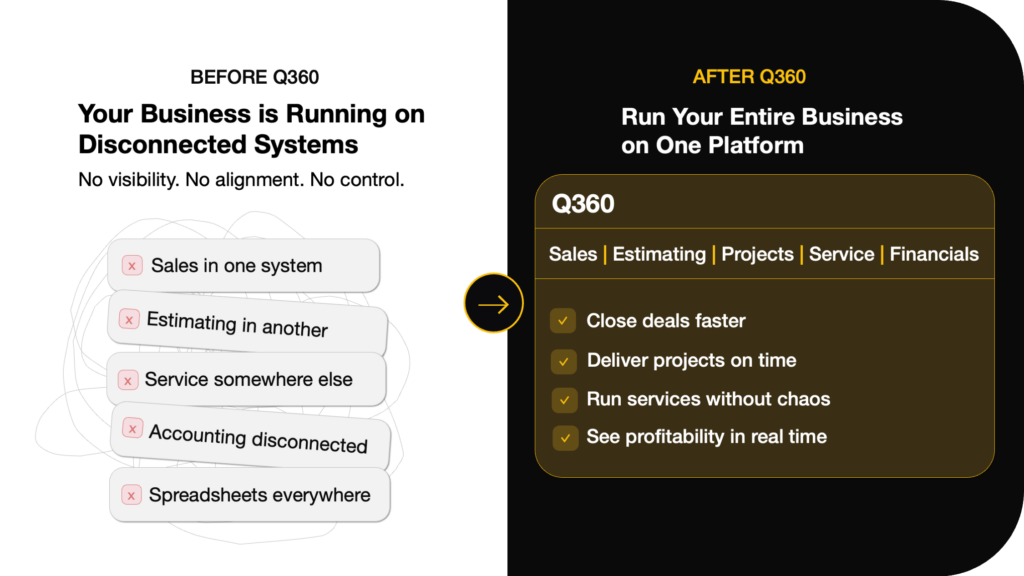
Q360 is purpose-built for technology integrators — the only platform that combines full project management, field service, service contracts, and specialized industry accounting in a single system. Job costs track in real time as labor is logged and materials are used. Technicians close work orders in the field and billing follows automatically. Multi-entity and multi-branch operations run from one platform. Nothing needs to be exported, reconciled, or manually transferred — because everything is already connected.
How They Compare for Integrators
| What Integrators Evaluate | Q360 | Quickbooks |
|---|---|---|
| Financial accounting | Native, full-featured | Basic / small business |
| Job costing | Real-time and detailed | Not available |
| Project Management | Built-in | Not available |
| Labor tracking | Built-in | Not available |
| Service & dispatch | Built in | Not available |
| Inventory management | Full ERP | Not available |
| Multi-entity / multi-branch | Built in | Limited |
| Overall fit for integrators | High | Early-stage only |
Choose Q360 if…
Your business runs on projects, field technicians, and service contracts — and you need your operations and financials connected in one system built for the integration industry.
Choose Quickbooks if…
You’re an early-stage business with straightforward financials and no immediate need for project management, job costing, labor tracking, or field operations.
Day-in-the-Life Comparisons
Here's what happens in real integration workflows — and where the platform difference shows up.
A project manager needs to know where a job stands financially.
In QuickBooks, job costing requires manual data entry from separate spreadsheets — labor hours, material costs, and change orders reconciled after the fact. In Q360, real-time job costing pulls from active time entries, purchase orders, and change orders automatically. The PM sees margin as the job progresses, not after it closes.
The company opens a second branch or acquires another firm.
QuickBooks has limited multi-entity support — most integrators end up running separate files and consolidating manually at month-end. Q360 handles multi-branch and multi-entity operations natively: one platform, one set of books, full visibility across locations from day one.
A service technician closes a call and the customer needs an invoice.
In QuickBooks, someone in the office manually transfers the service record into an invoice. In Q360, the technician closes the work order in the mobile app, time and parts are already logged, and the invoice generates automatically — without anyone touching it twice.
Ready to Move Beyond QuickBooks?
Q360 gives technology integrators the specialized accounting, project management, and field service tools that QuickBooks was never built to provide — all in one platform.